The Pathfinder Framework
The pathfinder framework and terminology developed by the Novo Nordisk Foundation Quantum Computing Programme (NQCP) and Quantum Foundry Copenhagen (QFC) are designed to advance the mission of achieving utility-scale quantum computing for applications in materials science and the life sciences. The pathfinder framework enables large-scale, mission- and data-driven R&D collaboration, using pilot-line projects to systematically evaluate and refine potential technological pathways.
The framework consists of
To cite the Pathfinder framework, use this reference: Zenodo repository.
Explore our beta version for estimating hardware resources in fault tolerant logic operations here:
The NQCP Mission Ladder

The NQCP mission ladder defines a progression in quantum algorithmic complexity, viewed through the requirements imposed on a hardware (HW) platform
- Level 9: Use-Case Simulation - Execution of materials- or life-science simulations that are infeasible with classical computing
- Level 8: Quantum Core - A full quantum logic circuit capable of performing the target L9 simulation while meeting defined performance requirements
- Level 7: Proxy Molecule - A prototype quantum computer executing a proxy circuit—a reduced, representative problem that captures the essential structure and complexity of the target application
- Level 6: +Magic - A universal gate set extending L5 with non-Clifford operations (e.g., inclusion of the T gate)
- Level 5: Logic - Implementation of the Clifford gate set
- Level 4: Error Correction - Quantum error correction operating above threshold
- Level 3: Parity Check - Parity-check operations (e.g., X- and Z-parity) - stabilizer measurement units
- Level 2: Physical Qubit Operations - Physical single- and two-qubit gates, including initialization and readout
- Level 1: Materials and Subsystems - Foundational hardware technologies enabling system development, including materials, fabrication, packaging, interconnects, control and readout systems, and supporting infrastructure. Progression up the mission ladder requires that all enabling technologies reach the corresponding sub-TRL (horizontal axis) needed to support increasing algorithmic complexity
The mission ladder is broadly applicable across fault-tolerant quantum computing (FTQC) architectures. Evaluation within this framework begins with a high-level objective: defining the target quantum circuit, along with the chosen HW modality and system architecture
The NQCP pilot lines
The NQCP pilot lines are full-stack hardware development projects, each defined by a target problem (compiled to a logic circuit) and a chosen hardware modality and system architecture to solve it. Pilot lines are interdisciplinary, cross-team development projects involving all R&D areas of NQCP, QFC and partners. The NQCP Mission Ladder is used as framework to create clarity on the maturity, potential and challenges of the pilot lines. Assessments of each pilot line are structured around five interdependent metric pillars: quality, speed, scale, power consumption, and system cost. For each pillar, metric trees are constructed along the mission ladder, enabling evaluation from L1 through L9 via targeted inform/enable projects. To estimate how metrics propagate from L2 to overall QC system performance at L7 or L8, depending on logic circuit complexity, the Resource Estimator provides an approximation.

Project management framework
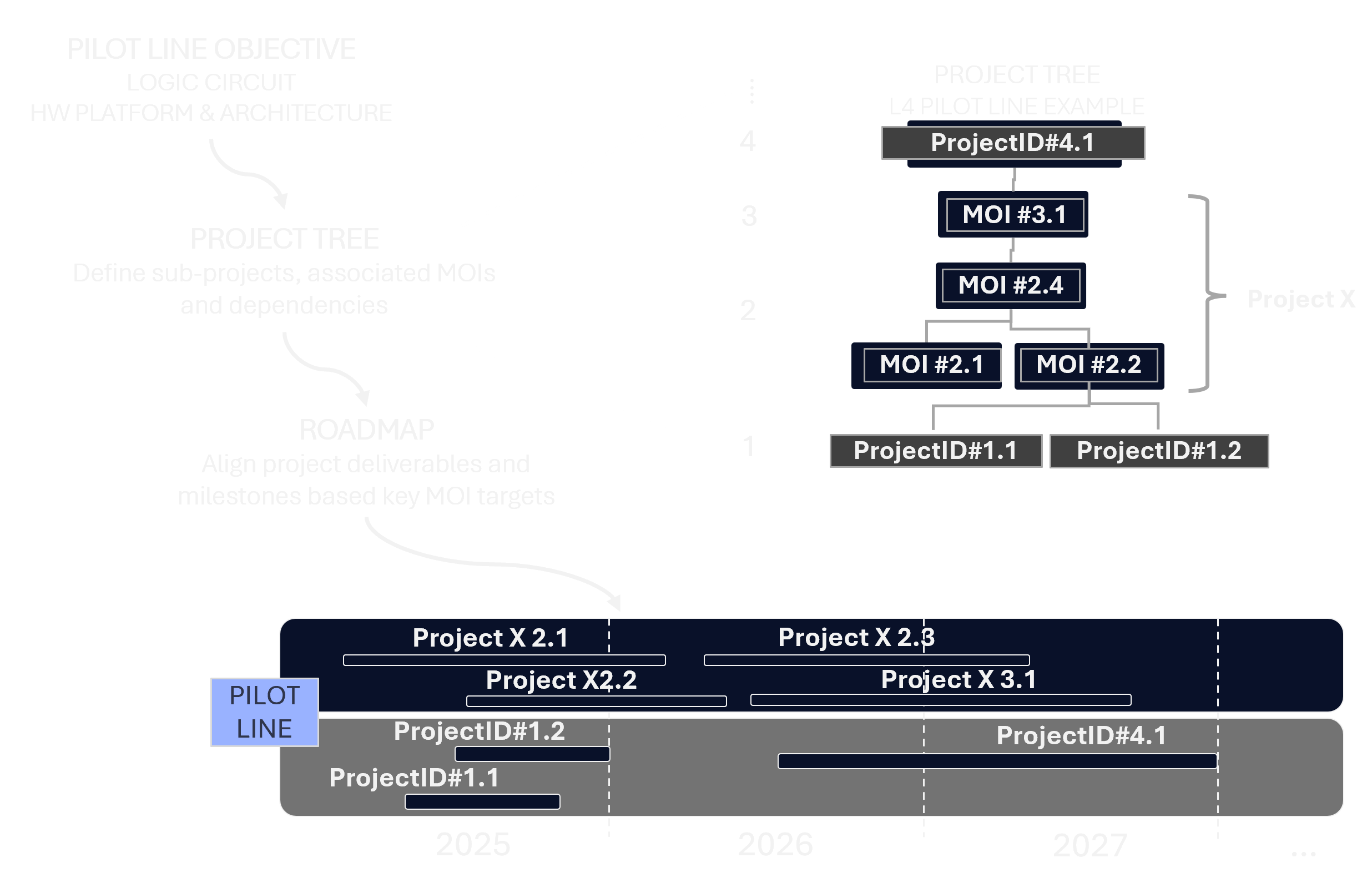
The NQCP Pilot lines comprise multiple sub-projects, each designed to achieve specific levels necessary to fulfill the pilot line’s objectives. ALL sub-projects is managed with clearly defined objectives in terms of targets for key MOIs. Dependencies between projects are coordinated through a shared pilot line roadmap.
Data driven workflows
The NQCP and QFC program is based on data driven projects, which runs through different levels of maturity but with a common effort to build capabilities for the pilot lines. A mission-driven project initiates a parameterized, data-driven workflow, starting with the listing an initial key parameter table for the project, based on four fundamental parameter classes. We distinguish data driven projects into four R&D stages:
- Exploratory
- Reproducibility
- Screening for key PCPs/DPs
- Optimization
Go to our data driven project guide here.
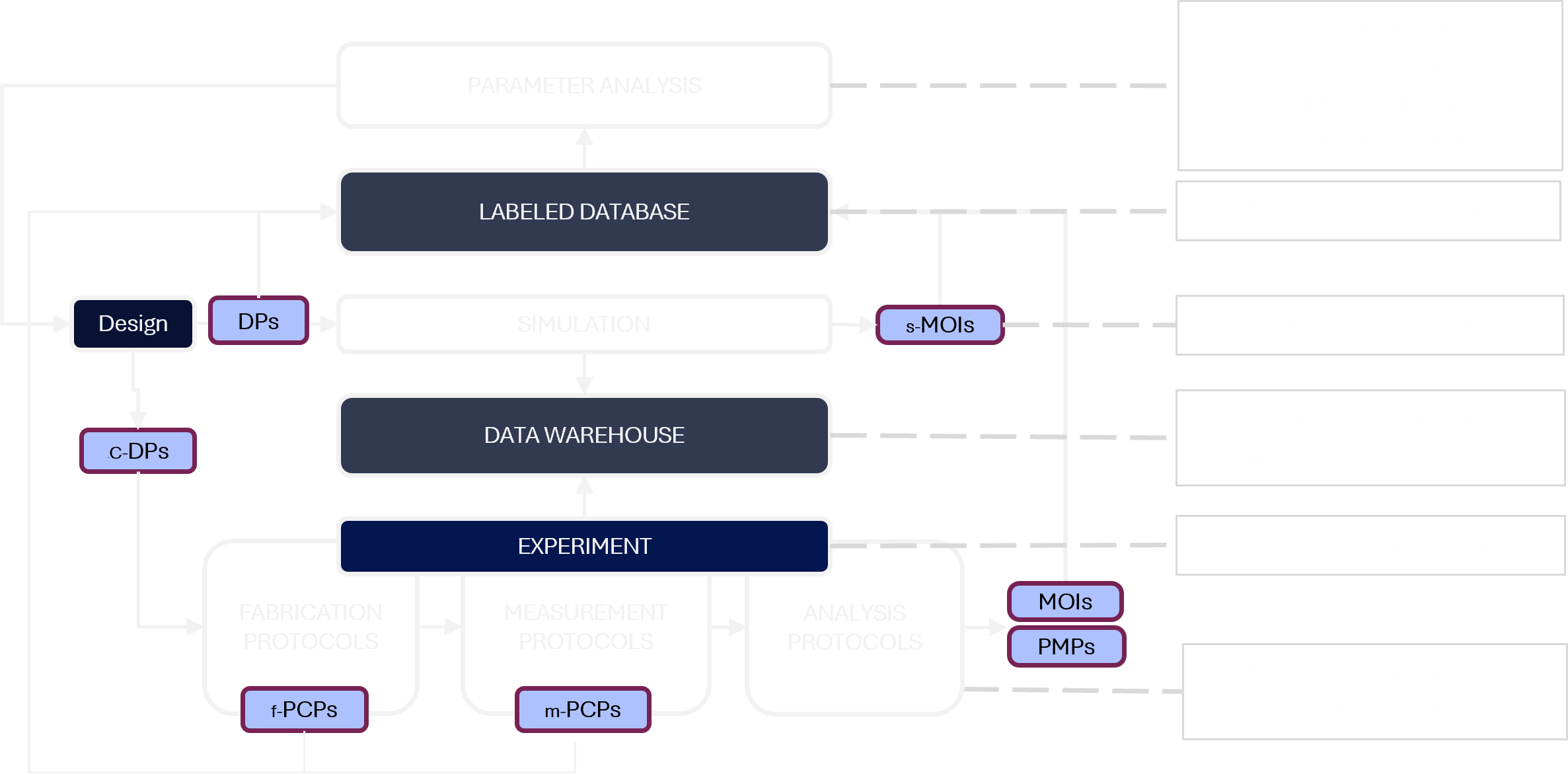
The data driven workflow within the projects of the pilot lines, is based on loops in design - fabrication - measurements - analysis - simulation - and parameter analysis. All raw data is stored in a centralized Data warehouse that include all data structured after pilot line, projectID, experimentalID, and timestamps, and a labeled database that holds all parameterized data. Bsed on the labeled database, knowledge graphs are contructed to capture the relationships between different parameters along the NQCP mission ladder.
OUTPUT
FIDELITY TARGETS
Documentation
Resource Estimator
Configure hardware fidelity, gate speed, quantum error correction, T-state generation, and gate/cost/energy parameters in the sidebar; results update live across levels L2–L7 (Physical Qubits, Detection, Correction, Logic, Magic, and Proxy Molecule). Algorithm presets can prefill logical-gate inputs for known workloads.
R&D Project Guide
Guides an experimental R&D workflow through four stages: exploratory single-shot experiments, reproducibility/process control, screening for critical process/control parameters (PCPs) via Plackett–Burman or Definitive Screening Design, and optimization of shortlisted PCPs via a central composite design (CCD).
c_QED Analytics
Solves circuit-element geometry for common superconducting circuit QED elements — rectangular and circular transmon pads and λ/2 coplanar waveguide (CPW) resonators — to hit target frequency and impedance given junction and material properties.
References
- Bay-Smidt et al., PRX Quantum (2025) — link.aps.org/doi/10.1103/gr4t-b1w5
- Rocca et al., J. Chem. Theory Comput. (2024) — doi.org/10.1021/acs.jctc.4c00352
- Jones, Phys. Rev. A (2013) — link.aps.org/doi/10.1103/PhysRevA.87.022328
- To cite the Pathfinder framework itself, use the Zenodo repository.